Maximizing Visual Impact with Eronami - Google Slide Template
Presentations remain a cornerstone of communication in professional, educational, and creative settings. The challenge often lies not in the content itself, but in how that content is visually structured to capture attention and convey meaning. A well-designed slide deck can transform complex data into clear narratives, while a poorly organized one can undermine even the most compelling message. This is where template-based approaches come into play, offering pre-built frameworks that balance aesthetics with functionality. Among these resources, the Eronami - Google Slide Template provides a comprehensive solution for users seeking efficiency without compromising on design quality.
Understanding the Scope of Eronami - Google Slide Template
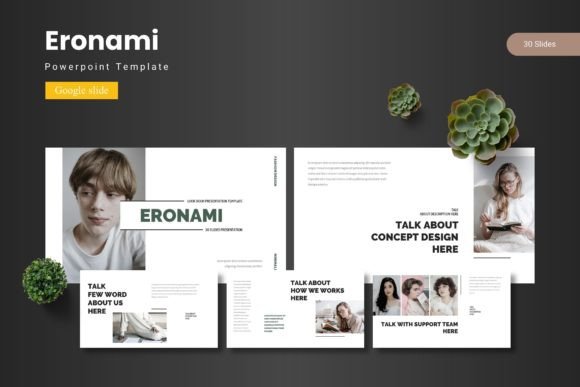
The Eronami - Google Slide Template is not merely a set of decorative slides; it represents a structured system for building presentations across various contexts. With a total of 150 slides organized into five premade color variations, this template offers 30 slides for each color scheme. This modular approach allows users to maintain consistency while adapting to different branding requirements or stylistic preferences. The inclusion of section break slides, handcrafted infographics, and master slides further enhances its utility for both linear and nonlinear presentation flows.
The template is built on a pixel-perfect illustration framework, meaning every graphical element is designed to maintain clarity and proportion across different screen sizes. This attention to detail reduces the need for manual adjustments, which is a common pain point when using less refined templates. Additionally, all graphics are resizable and editable, allowing users to tweak icons, shapes, and illustrations without compromising quality. The picture placeholder feature simplifies image integration: users can drag and drop their own visuals into designated slots, eliminating the need for complex cropping or formatting.
Color Variations and Design Consistency
One of the standout characteristics of Eronami - Google Slide Template is its five premade color schemes. These are not arbitrary palettes but cohesive sets designed to work together across all 30 slides per scheme. For example, a user might select a cool blue theme for a corporate financial report and a warm orange scheme for a creative portfolio. Each color variation includes matching section breaks, infographics, and typography guidelines, ensuring that the entire deck feels unified. This is particularly useful for professionals who need to present multiple topics under the same brand umbrella, as switching between color schemes is straightforward via the master slides.
The five color variations also cater to different audience expectations. Dark backgrounds with accent colors might suit evening presentations or tech-focused audiences, while light backgrounds with muted tones work better for academic conferences or client meetings. By offering these options out of the box, the template saves time that would otherwise be spent experimenting with color combinations.
Key Features at a Glance
To appreciate how Eronami - Google Slide Template fits into a broader presentation workflow, it helps to examine its core components individually. The template includes:
- 150 Total Slides: Distributed across five color schemes, with 30 slides per scheme. This includes title slides, content slides, section breaks, and specialized layouts like gallery and portfolio slides.
- Handcrafted Infographics: These are pre-designed visualizations for data, processes, and comparisons. They are built on master slides, making them easy to replicate and modify.
- Picture Placeholder Functionality: Designed for drag-and-drop use, these placeholders accept common image formats without distorting the layout.
- Resizable and Editable Graphics: All icons, illustrations, and charts can be scaled or recolored to match specific needs without losing fidelity.
- Master Slide Integration: This allows global changes—such as updating fonts or colors—across all slides simultaneously, which is essential for maintaining consistency in long decks.
- Section Break Slides: These create logical pauses between topics, helping audiences follow the narrative structure.
The main file includes five PPTX items from Google Slides, along with the 30 slides per color scheme. Additionally, a folder contains Google Slides readme first instructions, font details, and photo information, which aids in proper attribution and setup. This organizational structure reduces the learning curve for new users.
Infographic and Data Visualization Capabilities
Handcrafted infographics are a particularly valuable feature for presenters who need to translate raw data into digestible visuals. Rather than building charts from scratch, users can leverage pre-built timelines, flowcharts, and comparative diagrams. For instance, a marketing manager preparing a campaign review might use the provided timeline to show monthly milestones, while a researcher could use comparative diagrams to illustrate experimental results. These infographics are embedded within the master slides, meaning updates to data or labels can be made without affecting the overall design integrity.
The pixel-perfect illustrations included in the template cover a broad range of topics—from business icons to educational symbols—reducing the need for external image sourcing. This is particularly beneficial for users who lack access to premium graphic libraries or who want to avoid licensing complications. The illustrations are fully scalable, so they remain sharp when projected onto large screens or when exported as PDFs.
Advantages for Diverse Users
The Eronami - Google Slide Template serves a wide audience, and its advantages vary depending on the user's role and objectives. Below are several user groups and how the template addresses their specific needs.
Professionals and Business Owners
For corporate professionals, time is often a limiting factor. A consultant drafting a client proposal, for example, can select one of the five color schemes that aligns with the client's brand identity. The picture placeholders allow quick insertion of company logos and product images, while the handcrafted infographics can represent market trends or revenue projections. The section break slides help organize proposals into distinct phases—such as analysis, strategy, and implementation—making the document easier for clients to digest. Business owners who regularly pitch to investors will appreciate the polished look that reduces the need for external design support, potentially cutting down on preparation costs.
Educators and Researchers
Academic presentations often require a balance between clarity and thoroughness. The template's 150 slides provide ample space for detailed content without overcrowding. An educator preparing a lecture series might use different color schemes for different modules, helping students differentiate between topics visually. The gallery and portfolio slides are useful for showcasing project outcomes or fieldwork images. Researchers presenting at conferences can rely on the infographics to summarize methods and results, while the master slide system ensures that any last-minute changes to fonts or headers propagate consistently across the deck.
Creatives and Hobbyists
Designers, photographers, and content creators often need portfolios that showcase their work effectively. The dedicated gallery and portfolio slides in Eronami - Google Slide Template allow for image-heavy layouts without sacrificing text readability. The drag-and-drop picture placeholders simplify the process of updating content for different applications—such as a web design portfolio versus a print-ready PDF. Hobbyists organizing community presentations, such as for local meetups or workshops, can use the template to create professional-looking materials without needing advanced design skills.
Real-World Applications and Workflow Integration
Beyond individual use cases, the template integrates into common presentation workflows. Consider a scenario where a team collaborates on a quarterly review. One member might use the blue color scheme for financial data, another the green scheme for sustainability metrics, and then combine selected slides into a single deck. Because all slides share a common underlying structure—based on master slides—merging content from different schemes is straightforward. The font and photo information provided in the folder supports proper typography and image attribution, which is useful when presentations are shared externally.
The template also accommodates nonlinear presentations, such as those used in interactive workshops or training sessions. The section break slides act as signposts, while the variety of layout options—including comparison slides, process diagrams, and call-to-action pages—allow presenters to adapt their flow based on audience feedback. For example, a trainer might skip from a section break on "Key Concepts" directly to a portfolio slide showing case studies, then circle back to a data infographic as needed.
Customization and Practical Considerations
While the Eronami - Google Slide Template provides a robust foundation, customization is where its value truly shines. Users can override the premade color schemes by adjusting the master slides, creating a unique palette that matches specific branding guidelines. The editable graphics range from simple icons to complex illustrations, all of which can be recolored or repositioned without breaking the layout. For users who need to inject additional personalization, the template supports adding custom charts, videos, or animations, though these may require manual adjustment to maintain consistency.
One consideration is the learning curve associated with master slides. Users unfamiliar with Google Slides' master view might need to refer to the included "Readme First" instructions to fully utilize features like global font updates. However, once mastered, the template significantly reduces repetitive formatting tasks. Additionally, because the template is based on Google Slides, it is inherently collaborative: multiple users can edit the same deck simultaneously, with changes tracked in real time. This is a key advantage over static PowerPoint templates that require file sharing and manual merging.
Observations on Template Design and User Experience
From a design perspective, the Eronami - Google Slide Template emphasizes modularity and scalability. The 150 slides are not redundant pages but purposeful variations that address different presentation needs. For instance, some slides prioritize text-heavy content with ample whitespace, while others focus on visual storytelling through images and infographics. This variety means that users are less likely to need to create slides from scratch for niche requirements, such as a timeline with exact year markers or a portfolio grid with uniform thumbnail sizes.
The inclusion of five color schemes also reflects an understanding of diverse presentation contexts. In practice, many users may only need two or three schemes, but having the full set available allows for experimentation. A user might test a dark background with an audience accustomed to light slides and adjust based on feedback. The templates provide a safe environment for such trials without the risk of compromising design quality.
Comparisons with Other Template Approaches
Compared to generic template bundles that offer a large number of slides but little cohesion, the Eronami - Google Slide Template prioritizes interconnectedness. The fact that all 30 slides per color scheme share master slide settings means that changing a font or accent color updates the entire set simultaneously. This is not always the case with templates that mix multiple design languages within a single file. Similarly, the handcrafted infographics are tailored to the specific color schemes, ensuring that data visuals blend seamlessly with other slide elements rather than appearing as afterthoughts.
For users who have previously worked with templates that lack picture placeholders, the drag-and-drop functionality is a practical improvement. It reduces the time spent resizing images and aligning them within frames. The pixel-perfect illustrations further eliminate the need for external icon sets, which can be mismatched in style or resolution. However, it is worth noting that users with very specialized illustration needs—such as niche medical diagrams or proprietary product schematics—may need to supplement the template with custom assets.
Implementation Tips for Optimal Use
To get the most out of the Eronami - Google Slide Template, consider the following practical steps:
- Select a Primary Color Scheme: Review the five options in the context of your presentation's audience and content. For external client decks, neutral schemes like gray or navy often work best; for internal creative reviews, bolder colors may be appropriate.
- Leverage Master Slides for Consistency: Before adding content, customize the master slides with your organization's fonts, colors, and logo. This ensures that every new slide you create within that scheme adheres to your brand guidelines.
- Utilize Section Breaks Strategically: Insert section break slides at natural transitions in your narrative—such as between problem statement and solution, or between background and analysis. This helps audiences mentally organize information.
- Replace Placeholder Images Early: Use the picture placeholder feature to insert your own visuals as soon as possible. This prevents last-minute layout issues and allows you to see how text and images interact together.
- Test Across Devices: Since Google Slides renders differently on various screens, preview your deck on both desktop and mobile views. The pixel-perfect illustrations generally scale well, but text-heavy slides may require minor adjustments on smaller displays.
- Collaborate Using Google Slides Features: Share the file with team members and use comments and version history to track changes. The template's structure supports collaborative editing without corrupting design elements.
These tips are applicable whether you are building a presentation from scratch or updating an existing deck. The template's extensive slide count means you rarely need to design new layouts, but when you do, the master slide system provides a foundation that keeps all additions consistent.
Addressing Common Challenges
One challenge users might face is information overload when faced with 150 slides. It can be tempting to use every slide type, but this can lead to cluttered presentations. A better approach is to select only the slides that serve the narrative—for instance, choosing one infographic style per data point rather than using multiple comparison diagrams for the same set of numbers. The template is designed to offer choice, not enforce complexity. Similarly, the five color schemes should be used discretely within a single deck unless there is a specific reason to switch themes (e.g., differentiating sections by topic).
Another consideration is the font and photo information provided. While the template includes guidance on recommended fonts and image sources, users should verify that their chosen fonts are available in Google Slides or loaded externally. The "Readme First" folder contains details on this, so consulting it early in the process can prevent formatting issues later. For photographs, the information likely includes attribution requirements if images are sourced from third-party sites; adhering to this is important for both legal compliance and ethical practice.
On a broader level, the Eronami - Google Slide Template exemplifies how modern template design moves beyond static backdrops toward integrated systems. The combination of handcrafted infographics, master slide control, and cross-scheme consistency reflects an understanding that presentations are not just about showing information but about guiding an audience through a logical sequence. When used thoughtfully, the template can reduce the cognitive load on both the presenter and the viewer, allowing the content to take center stage.
In practice, this means that a user can spend less time on slide mechanics and more on refining the message. Whether it is a sales pitch, a classroom lecture, or a community workshop, the structural support provided by Eronami - Google Slide Template enables presenters to deliver their ideas with confidence. The real-world relevance lies in its adaptability: it works for a one-off presentation just as well as for a recurring series, and it scales from individual use to team-wide projects. By removing the friction of starting from a blank canvas, it allows creativity and clarity to coexist within a consistent visual framework.