Cerutas – The Google Slide Template That Transforms How You Present Ideas
Presentations have become a core medium for sharing ideas, pitching products, and teaching concepts. Yet many professionals still struggle with slides that feel cluttered, outdated, or misaligned with their message. The rise of remote work and digital collaboration has only intensified the need for clean, adaptable, and visually coherent templates. Cerutas – Google Slide Template enters this space as a practical solution that balances aesthetic appeal with real-world functionality. It offers 150 total slides across five premade color schemes, making it one of the more comprehensive options available for anyone who regularly builds presentations.
What makes Cerutas particularly relevant today is how it addresses a common pain point: the tension between creative flexibility and time constraints. Instead of starting from a blank canvas, users get a structured yet editable framework that works for pitches, portfolios, reports, and educational content. This article explores why Cerutas matters, how it fits current presentation trends, and how you can use it to communicate more effectively.
Why Presentation Templates Are Evolving Beyond Simple Decoration
For years, presentation templates were little more than decorative skins. You picked a color, dropped in your text, and hoped it looked professional. But modern audiences expect more. They want clarity, visual rhythm, and a narrative that guides them slide by slide. This shift has pushed template designers to think about structure as much as style. Cerutas – Google Slide Template reflects this evolution by offering section break slides, handcrafted infographics, and picture placeholders that streamline the layout process without restricting creativity.
The template leverages Master Slides, which means changes you make to a master element apply consistently across related slides. This is a game-changer for anyone who has spent hours manually adjusting fonts or repositioning images across a deck. With Cerutas, you maintain brand consistency while saving time. The five color variations included in the package further support this adaptability, allowing you to match company palettes or personal preferences without rebuilding from scratch.
Another reason templates like Cerutas are gaining traction is the growing expectation for visual storytelling. Audiences no longer tolerate walls of text. They respond to infographics, clean typography, and imagery that supports the spoken word. Cerutas includes pixel-perfect illustrations and resizable graphics, so you can create diagrams and data visualizations that feel intentional rather than thrown together. This aligns with broader communication trends where clarity and design quality are seen as proxies for credibility.
The Practical Value of 150 Slides Across Five Color Schemes
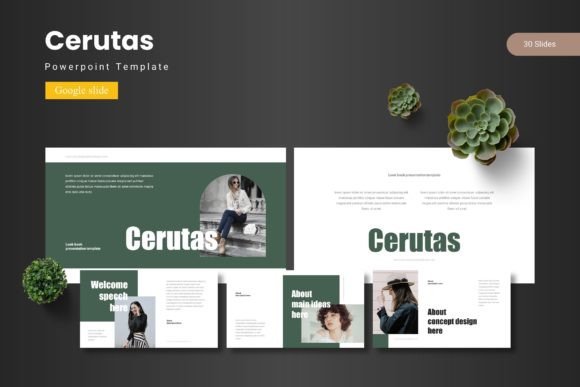
One of the standout features of Cerutas is its sheer volume of content. With 150 total slides and 30 slides per color scheme, you are not limited to a single look. This matters more than it might first appear. Many professionals need to create multiple presentations for different audiences—perhaps a client pitch, an internal update, and a conference talk. Having a unified template system with distinct color options means you can switch contexts without starting over.
The 30 slides per template include a variety of layouts: title slides, content slides, section breaks, gallery and portfolio slides, and infographic-based pages. This variety allows you to build a narrative arc rather than just a sequence of bullet points. For example, a section break slide with a bold background color signals a shift in topic, helping your audience mentally reset. A portfolio slide with image placeholders lets you showcase work without wrestling with alignment.
How the Template Structure Supports Different Use Cases
Imagine you are a marketing consultant preparing a quarterly review. You might use the dark color scheme for the executive summary, the vibrant palette for campaign results, and a muted tone for strategic recommendations—all within the same deck. This kind of flexibility is rare in off-the-shelf templates. Cerutas makes it possible because the five color variations are coordinated across the same slide architecture. You are not learning a new layout each time; you are simply adjusting the mood.
Cerutas – Google Slide Template also includes picture placeholders with drag-and-drop functionality. This is a small detail that has outsized impact on workflow speed. Instead of cropping, resizing, and repositioning images manually, you drop a photo into the placeholder, and the grid adapts. The same applies to icons and infographic elements, which are fully resizable and editable. This means you can tweak colors, scale graphics, or rearrange components without breaking the design.
Why Infographics and Master Slides Matter for Clarity
Infographics have become a cornerstone of effective communication because they distill complex data into digestible visuals. But creating infographics from scratch is time-consuming and often requires design skills most professionals do not have. Cerutas addresses this by including handcrafted infographic slides that are built on Master Slides. This means the underlying structure is consistent, but you can customize the data points, labels, and icons to fit your specific numbers.
Consider a scenario where you need to present market share trends. Instead of building a chart in Excel and pasting it into a slide, you could use an infographic template with proportional shapes and callouts. The visual difference is significant: data feels integrated into the design rather than appended to it. Audiences remember what they see, and a well-crafted infographic can make your argument stick long after the presentation ends.
The use of Master Slides also means that any global adjustments—like changing the font family or updating a color accent—propagate instantly across all slides. This is especially valuable for educators and freelancers who may need to repurpose a deck for different courses or clients. You maintain a professional look without repeated manual effort.
How Cerutas Fits Modern Workflows and Collaboration
Google Slides is already a collaborative tool, and templates like Cerutas extend its usefulness. Because the template is delivered in a format compatible with Google Slides, your team can work simultaneously on different sections. The 5 PPTX files included also ensure compatibility with PowerPoint if needed. This hybrid approach reflects the reality of modern work: you might start a deck in Google Slides for cloud sharing, then finalize it in PowerPoint for a presentation on stage.
The folder structure provided with Cerutas includes a Readme First document, plus font and photo information. This might seem like a small touch, but it reduces the friction of getting started. You know exactly which fonts are used and where to find similar photography if you need to extend the deck. For busy professionals, this clarity is valuable. You spend less time troubleshooting and more time refining your message.
Practical Recommendations for Getting the Most Out of Cerutas
- Start with the section breaks. Use them to map out the major chapters of your presentation before filling in content slides. This gives you a bird's-eye view of the narrative flow.
- Leverage the five color schemes strategically. Use one scheme for the main content and another for appendices or supplementary slides. The visual contrast helps audiences differentiate core material from supporting information.
- Replace placeholder images with your own visuals. The drag-and-drop functionality makes this fast, but take time to choose images that reinforce your message rather than just decorate the slide.
- Customize infographic elements to match your data. The handcrafted infographics are designed to be edited, so adjust the shapes, labels, and colors to reflect your actual numbers. This adds authenticity to your presentation.
- Use the gallery and portfolio slides for showcasing work. If you are a designer, photographer, or architect, these layouts allow you to present multiple visuals cleanly without overcrowding the slide.
Why Attention to Detail Matters in Template Design
Not all templates are created equal. Many offer generic layouts that look good on a demo page but fall apart when you try to customize them. Cerutas distinguishes itself through pixel-perfect illustrations and graphic elements that remain crisp even after resizing. This attention to detail is not superficial—it affects how your audience perceives your professionalism. A slide with misaligned elements or distorted icons sends a subtle signal of carelessness. Conversely, a slide where every element feels intentional builds trust.
The inclusion of 150 slides might seem like overkill for a simple presentation, but it provides a valuable library. You can pick and choose the layouts that fit your content rather than forcing your content into a limited set of options. This modularity is especially useful for longer presentations, such as training sessions or annual reports, where variety helps maintain audience engagement.
The Broader Context: Why Visual Communication Skills Are Increasingly Valued
We are living in an era where attention spans are short, and information overload is real. The ability to communicate visually is no longer a nice-to-have; it is a core professional skill. Templates like Cerutas lower the barrier to entry for people who do not have design backgrounds. They offer a starting point that is already polished, so you can focus on what you want to say rather than how to say it visually.
This trend is reflected in how businesses now invest in brand guidelines that extend to presentation decks. A consistent visual identity across slides, documents, and websites reinforces brand recognition. With Cerutas, you can apply your brand colors by choosing the palette that matches or by customizing the color scheme further. The five included schemes serve as a shortcut, but the real power lies in your ability to adapt them.
For educators, the template offers a way to create course materials that feel contemporary without requiring graphic design skills. Students respond well to clear, visually engaging slides, and the infographic elements can help explain complex concepts more effectively than text alone. Freelancers and entrepreneurs can use portfolio slides to showcase their work in a structured yet visually appealing way during client meetings.
Final Thoughts on Using Cerutas in Your Workflow
Ultimately, the value of any template depends on how well it serves your specific needs. Cerutas – Google Slide Template is designed for flexibility, volume, and ease of use. Whether you are preparing a sales pitch, a university lecture, or a creative portfolio, the 150 slides across five color schemes give you options without sacrificing consistency. The handcrafted infographics, picture placeholders, and Master Slides-based structure reduce repetitive work and let you focus on content.
If you are tired of wrestling with slide layouts or starting from scratch each time, Cerutas offers a practical foundation. It respects your time while elevating the visual quality of your presentations. In a world where how you present is as important as what you present, having a reliable template system is not just convenient—it is strategic.